In Memory of My Dad #36–relatives

I’m so glad to have discovered a story from my dad to share with you today.  Months ago, my sister sent via her husband, a large canvas box filled with Tahlequah Times Journal newspapers from the years my dad worked there.  I thought I had shared all the “stories” and was left with sports articles of how the Tulsa Hurricane Little Leaguers won the Championship or Arnold Palmer’s hole-in-one.  But today, I uncovered some more commentaries.  This one was written on Sept. 14, 1996 by my dad Bob Briggs.  I miss him dearly.  I wish he were here with me this morning, stoking the fire, listening to some classic rock, drinking coffee on this frosty December morning as we look forward to little Miss Emma Kate to arrive in  six short weeks (give or take a day or two).  He would’ve liked this day.

She was always a heroine of mine.  I admired her from day one when we were attending a small country school there at Briggs, Oklahoma.  We walked the long miles to school together and talked of many things, of the many dreams that two country kids knew the outside world held for them.

She, being a couple of years older than me, always took my part when I got into a skirmish with the older boys.  You know how kids on kids are?  That’s the roughest kind of play there is and the girl was also a pretty good rough and tumble fighter herself.

She never had much time or even the chance to be a child herself.  Her mom worked at many menial jobs trying to hold her small family together after the girl’s father left.  She was regulated to the task of caring for her younger sisters and brothers—so there went her childhood.

Then, one day, the girl was gone from the small house on the south side of town where she had lived with her siblings and hard-working mother.

She had married a young man and moved out of state.  She was 16—so there went her teenage years.

When she could have been readying herself for the prom and having fun with her friends, she was busy having children of her own and keeping house for the man she chose to be her lifelong mate.

I don’t recall seeing the girl smile much as a child.  There weren’t many occasions for her to smile in later years either.  The man she married, though a boy himself, drank to excess and was generous to a fault.  But I’ll say this for him, he never missed a day’s work.

The three children she and her husband produced, grew into teenagers and faced the typical teen problems of today, but she went the extra mile to see the kids were raised up with Christian values.

I guess I was always proud of the girl that became a woman more out of necessity than the process of growing.  She went back to school and earned her diploma and learned to drive a car after she was married.  She worked for a newspaper in west Texas and stuck with her husband until he quit the whiskey.  And mightily fought the drug demons along with her son.

Now she and her husband have a house full of grandchildren and three well-adjusted children.  And when she should be kicking back and enjoying the fruits of their labor, she is girding her loins for a battle the doctors have no name for.  She’s been religious most of her life and I hope it carries her through these trying times.

I’m writing this on her birthday so she’ll know that my love and prayers go with her.  Happy Birthday, sis.  May you have many more years of happiness.

****************************

Speaking of relatives, my brother surprised me a couple of weeks ago by inviting me to his place for a T-bone dinner.

Being the type that haunts fast food places and convenience stores I readily accepted.

He put the potatoes on to slow bake and the corn-on-the-cob went into a large pot on the stove.  Then he peeled the lid from a bottle of Jim Beam and we retreated to the patio where the coals were just beginning to turn a nice shade of grey and plopped two inch-high steaks on the grill.

The hour we waited for the steaks turned into three and we talked of new cars and old friends.  Relatives make good fodder for conversation when you’re in the process of getting into the cups and non of ours (except unknown grandfathers and our three sisters, who are saints) escaped unscathed.

Cousins, uncles, aunts and brothers-in-law all were praised or caught hell with equal zeal and fervor as the levels dropped steadily on the bottle.

About mid-night, I was treated to one of the finest charcoaled steaks I’ve ever laid into.  My brother rummaged through his lower cabinets until he found a long forgotten six-pack of Busch and we talked on and on till the early morning.

My brother became so adament on one point of the conversation, he said, “That’s the truth, brother, and if it ain’t, I hope that moon up there comes flying through the air and crashes into the earth.”

Later on we slept.

I was awakened by the pattering of rain of a passing storm.   My brother slept peacefully in his chair as Sissy, his chowdog, slept at his feet.  I looked through the branches of the huge evergreen that graces his bakyard and saw the low flying rainclouds as they made their way toward Adair County.  The clouds broke a little and there was that moon—-that sucker hadn’t moved a bit.


In memory of My Dad #35

Written November 25, 1993 by my dad Bob Briggs while writing for the Tahlequah Daily Times Journal

It’s almost December and pheasant season is about to open the panhandle of Texas.  Pheasant season only stays open for two weeks there, so you’d better get out and get some while the season is open.

Pheasant are hard to see if you don’t know what you are looking for.  I’ve seen the brightly colored birds disappear in a field of green winter wheat, and not flush until you’ve nearly trampled the beggars.

My old buddies, P.J. and “The Sarge” used to load up in Sarge’s Bronco, with a bottle of “lying Whiskey” and road hunt for these wily birds.

Now I don’t recommend that you road hunt because it’s highly against the law, but when you’re young and living in West Texas, outfoxing the game warden is just a part of the game.

We were crazy about shooting these birds.  One time P.J. had me stop in downtown Waka, Texas, jumped out of the vehicle and killed a rooster pheasant in broad daylight.  Now I’ll admit, Waka isn’t much of a town but it’s big enough to have a local constabulary of some sort that could put a man in the  for some little time.

I tripled on a covey of pheasants once up by the town of Spearman, Texas.  I was hunting alone down in a wet lands draw that had dried up and was overgrown with weeds.  That is sort of like making a hole in one without a witness.  It don’t do any good to tell anyone because they say, “Yeah, right.”

I sure miss those days.  This cold weather snap just makes it worse.  Getting up early in the morning, putting on your hunting coat with the peppery smell of blood on it, the weight of number 7 shot weighing on your shell loops.  If you’re going to be legit that day and hunt on land where you already have permission, your dog seems to sense that he’ll be going with you and he’s excited as any athlete before a game.

I don’t know about P.J. or how the hunting is around Chicago, but I know “The Sarge’ will have somewhere to hunt this year.  I hear the hunting’s pretty good out around Farmington, New Mexico where he’s been said to hang his boonie hat. 

As for me, I’ll just kick back and think about those long ago days when a walk in the field or a slow drive down a section line meant meat in the pot.

Good hunting, fellows.

In Memory of My Dad #34

Written by Bob Briggs—1994

Fear is a terrible thing, pure unadulterated fear is a mind numbing, limb freezing, feeling that turns your insides to water.

I wonder what kind of fear Scott Donner  felt in San Antonio, Texas that day in 1993 when he let fear take control, and clambered back down the 10 meter platform from where he was to take his final dive.  It was a moot point dive as he already had first place sewed up.

But Donner didn’t take the dive, he went into his pre-dive routine and performed a handstand prior to taking th plunge.  The dive shouldn’t have taken over ten seconds, but Donner continued to remain there balanced on his hands 20 seconds, 30 seconds, like a statue.

Finally after about forty seconds, his legs wavered twice and Donner lowered his legs until he was standing straight upright on the platform.  He then climbed slowly down to where his friends and family waited and wondered.

Donner said he suffered from post-traumatic-stress, a Vietnam-veteran disorder, but what he was really suffering from was not making it big on the endorsement trail.  Donner said that he felt an immense feeling of relief when he walked off the platform.  He didn’t need this.  Donner had a fear that he would change his mind in the middle of a dive and hurt himself.  He dove beautifully in the 1992 Olympics, he dove well enough to win a Silver Medal in the 10 meter platform.  A 10 meter dive is like diving off the eaves of a two story house, or out the window of a three story apartment.  You also have to cup your hands over your head, pushing a hole in the water with your hands before your head hits the water.

Donner says that he has seen many people get hurt in the platform dive.  You are entering the water at 35 mph and to hit anything but a near perfect dive could be disastrous.  So Donner came home from the Olympics with his Silver medal all ready to take on the corporate world.  He admits he made mistakes when he didn’t hire an agent to make deals for him.  He thought he could do it on his own.  He didn’t realize that an Olympic Champion’s light burns hot and quick.  If you don’t have some one out there in front singing your praises, you’re not going to do any selling on the market today.

So Donner started to eat an atrocious diet, he started to drink and smoke cigarettes, he started to drive fast on empty streets with no thought in mind except not getting arrested, in short he had turned into someone that I would have liked.

Donner wrecked his car on a rainslick Florida highway last spring, if you expect me to tell you that he was crippled in an accident, he wasn’t.  He says that he may be back for the ’96 Olympics if he makes the team, but this time he won’t  be fighting an unknown fear in his mind.  So much for the story.  I don’t know if I believe it or not, I do know some ‘Nam vets that should be kept in a box, but that’s another story.

Speaking of vets, I had a chance to hear Randy Crouch play the other night at a gathering of veterans and friends at the river for the annual Blue Note Festival.

Randy is the heart and soul of the band, the Flying Horse, a 3, 4, or five man combo that belts out rock, country or reggae at warp speed or whatever else that your ears can stand. 

Randy’s main guitar player, Sparky Fisher, passed away this past summer and so whatever guitar player that’s available now can sit in with the band.

Randy is a fiddle player of par excellence, and when he drags that bow across those strings for a rendition of The Star Spangled it is worth traveling more than a few miles to hear.

I arrived at the campground where they were holding the Blue Note Festival at just about sundown and a lady cold jumped me at the gate for a buck’s donation to “cover expenses” of which I’m all for, I just don’t like surprises.  Because most time when I go to the river, I don’t carry money with me, but this night knowing that I’d probably be seeing my brother among others, and not knowing what would transpire, I had a few extra dollars.

So paying my buck stipend I drove on into the party.   I arrived just in time to see my brother playing a splendid rendition of Dan Garber’s or Doc Davis’ “Adair County”— and doing the song some decency.

You have to do some pretty deep research to find out the author of most of these original Green country songs, and the passage of years and the combination of many factors have dulled the senses of many of my friends and so their arguments continue.

Brother Goose did another song or two and then came down from the bandstand to howdy and shake with the many folks gathered there under the trees.

He likes to get his commitments over with as soon as possible so that he can say “yeah, I was at so and so’s party, and yeah I played.”

When in reality all he wants to do is get away from the office and toast a few with his friends.  He figures the best way to accomplish that is to get his musical talents out of the way so that he can hang at the fringe of the crowd and check out all the new swim suit styles.

But back to The Flying Horse Band, there were some nights when the band could walk with the king, or anybody else for that matter.  There were times when the band was the absolute best that you’d ever heard.

When Randy would stand there with fiddle in hand and an electic guitar slung around his neck fiddling with the volume and bass controls with his bare feet, while all the crowd got down with him on one of his patented songs.

Then some nights Randy gets just as rowdy and noisy as the others and always plays as smooth as unblemished silk.

But every now and then he gets it in his head to go out and dance with the big boys, and on those nights Randy Crouch is special and can make music with anybody.  Go on, get one of his tapes that one of his friends have boot-legged, crank  it up and stand back among the mainbeams and you’ll know what is was to hear some real men play some real rock and roll.

In Memory of My Dad #33—Armadillo

No matter how many times I leave Tahlequah, I’m always ready to return to the old hometown—but first, I had a commitment to some friends in another town to take care of before my departure for home. I had already said goodbye to my two daughters, and after a rousing night in Donny Duree’s bar, I said adios to the Golden Spread and headed southward toward where my friends live.

3:00 a.m. is what the digital read out on the clock beside my bed said in bright bold numbers—the drinkers hour.  Drinkers all over America were coming awake at this hour, staring at the shadows as they prepared to do one more dance with the demons.  I was no different as I went into the bathroom, washed quietly, then went into the kitchen to prepare a huge pot of coffee prior to leaving.

The morning breeze was cool on my face on that morning drive south.  The eastern sky was turning a pale salmon pink, when all the coffee that I’d drank teamed with the beer from the night before and told me it was time to stop and check the atmospheric pressure–I lifted my foot from the accelerator and let the pickup coast to a stop beside a wild plum thicket.

I was standing there admiring the sunrise when an uncommonly amount of noise came invisibly through the shinnery.  Whatever it was I felt vulnerable standing there dressed in nothing but a pair of cutoff wranglers with a twosome of ratty flip-flops on my feet.

Squinting into the semi-darkness and trying to walk backward and keep the loose shower shows on my feet and fumbling with my zipper, I sat right down in a patch of sandburrs.  Sandburrrs are God’s bane to the barefoot traveler.  They pierce the skin so easily and once they’re in the flesh they curl into unforgiving hooks that bring grown men to tears when they’re being removed.

I was glad for the darkness as I removed my shorts and tried to get the miniature hooks from my hands, feet and posterior.  I was working diligently on my hands and feet, when something that resembled a basketball tumbled down the embankment and started making its way toward my pickup.

“Hey Bob, that’s an armadillo.”  I said.  I had seen plenty of the little creatures dead alongside the highways, but in my short lifespan this was my first encounter with a live one.  The creature moved like a live steel helmet snuffling and poking its small nose into every nook and cranny until at the last instant my scent must have wafted gently on the morning breeze and the little armored one veered off and unhurriedly made its way down the bar ditch.

I stopped at a roadside park and hour or so later and who should pull up but a member of the Fish and Wildlife Division.  so I thought why not do a little impromptu research on the little critters. 

I found out that the armadillo was named by the conquistadors as they made their way through Mexico and the Southwestern United States.  But most Texans today simply refer to them as diggers because of their penchant for digging for larvae and grubs.  My Dad used to call ’em ‘borers” and swore that they fed on the newly buried.  I never knew he was talking about armadillos though.  I’m certain that  armadillos looked for grubs or what have you in freshly dug graves, but going down 6 feet and through a couple containers for your dinner seems a little far-fetched and the game ranger assured me that it was.  There goes another old wives tale out the window.

The game ranger, while admitting that he was no expert on the subject of ‘dillas, said that it would be fitting if they did feast on the dead because poor whites cooked the ‘dillas with a mess of greens and cornbread where during the Depression they became known as “Hoover Hogs” or “Texas Turkeys’ and graced many holiday tables.  Even today, some poor blacks still  barbecue the soft meat of the ‘dilla and consider it a delicacy.

Ancient Mayans refused to eat the armadillo because they believed that common vulture did not die but metamorphosed itself into an armadillo.  Smart people, the Mayans.

But the young ranger assured me things were going better for our Cenozoic cousins now.  Texas law protects the hardy reptile from the exploitation of commercial hunters and that means it would be harder to find a lampshade or a purse made from the skin of one of the tiny varmints.  The main concern of the armadillo today is to keep from getting its remains pressed into the asphalt by passing cars as they amble myopically down life’s highways.

It was coming onto noon by now and I just passed the outskirts of Quanah, Texas when I thought that I’d stop for a quick bite to eat.  Quanah is named for the great Comanche war chief Quannah Parker, born of mixed parentage.  Parker, a self-styled hellion, made things tough for the Texas Rangers just before the turn of the century.  His name means “fragrant flower” in Comanche and was said to be the cause of many-a-fight with Quanah’s boyhood pals.  But writing about him would take up a whole column, so we’ll let that slide for now. 

The Dairy Queens and the drive-in parking lots were filled with cars and pickups and the few promising looking steakhouse lots were filled also, so I opted for one of those plastic, laminated looking places called the Brewbaus or Der Schnitzel Palace or something like that.  I knew I was in trouble when the menu read “order by number please”.  I ordered number whazzit and received a grey-colored wiener covered with sauerkraut and a mixture of slurry that was supposed to be German potato salad.  The wiener squeaked like I was chewing on rubberbands and the potato salad had the consistency of and tasted like wallpaper paste.

I sat there chewing this untasteable mess and found myself wishing  I had a hunk of that barbecued Hoover Hog and a good mess of turnip greens.

~ Written by Bob Briggs
1943-2011

In Memory of My Dad #29

Whizbang Red was the luckiest fisherman I ever encountered on a golf course in my life. I’ll tell you why.

Whiz was trying to retrieve a lost golf ball that he had sent to a watery grave when he hooked a seven and a half pound bass, and actually landed the thing, much to the chagrin of Rick Archer, our resident pro fisherman at MapCo out in West Texas.

Whiz wasn’t a bad guy, he was just awfully hard to be around, what with all his bitchin’ and crying.  I think that Whiz would gripe if they were going to hang him with a new rope, or at least be opinionated enough about the whole mess that he would give you second thoughts about hanging him.  You’d just want to go home and relax with a tall glass, rather than go through with the hanging.

And the man was an awful cheap golfer.  He’d slice one out-of-bounds and then spend 15 or 20 minutes looking for the ball, cussin and slashing weeds and whatever greenery that was growing along the golf course.  One thing, Whiz found a lot of golf balls no matter if they were beaten, scuffed and worn.

I was playing with Red that beautiful April morning, I had him about three holes down with but one hole to play on the front nine of Huber Golf course over near Borger, Texas.  To say there were a few obstacles on the course would be an understatement.  You may have to dodge a well-servicing crew working on one of the four oilwells on the course, or you could lose your ball to an armadillo family rustling around the sand dunes where they like to burrow. 

Whiz and myself came to the ninth hole, a medium long-par four.  It’s one of the three holes on the course in which water comes into play.  The hole played easy if you could turn the ball over—there was a nice level place down by the water that we called the “sweet spot”.  If you landed there with your tee-ball, you had an easy flip wedge shot to get home.

I hit a good tee-ball, and had maybe a 75 yard shot to the green and Whiz cut his ball out to the right and 140 yards over some big willow trees.  He tightened up visibly on the shot and dumped his tee-shot, “ker-plunk,” right in the greenside pond that fronted the ninth hole.

I put my ball on the green and two putted for a routine par while Whiz went on one of his world famous cussing sprees.  “Blankety-blank #&$!*#(#@#$%$#%%^^!!@$%$”  This was why I hated to play with Whiz, he was an embarrassment to be with.

Whizbang was playing a fairly new orange ball of some kind, one that he had found on the eighth hole, when he had hooked his teeball wildly out-of-bounds.  I didn’t know when he’d pay me the buck that I had coming, so I just said Adios and went home.

Early the next morning I had a game with a long-knocker by the name of Cryer.  Longcryer was a lefty and was armed with a driver that had crippled more people than polio.  We were both on the driving range warming up when the Frito-Lay panel truck that Whiz drove came clamoring up and parked right next to me and Cryer’s pick-ups.  We had all had experience dealing with higher ups and we frequently hid our vehicles next to the honeysuckle vine hedges and the sunflowers over by where the clubhouse was separated from the clapboard building.  This was where old men drank beer and wiled away the hours playing moon for 25 cents a game and 25 cents a hickey.

Whiz immediately started in on the lost ball: “That was no ordinary ball.  It was a new Pro Staff—you can see that ball from anywhere on the course.  Everyone is trying to buy one, you can’t find them just anywhere.”

“So what’s that got to do with that fishing equipment?’ asked Cryer, sensing another pigeon.  I moved closer to add my two cents worth, since I’m not adverse to cutting someone up like a boarding house pie when it comes to a golf match, especially a lame like Whiz.

To say Whiz was not a fisherman, is like saying Mr. Ed is not a Kentucky Derby hopeful.  Whiz said that he broke the “twine” twice while tying on the huge orange rapella lure onto the rod.  Twine hasn’t been used in fishing since the invention of safety pins.

Orange ball, orange lure; a coincidence, who knows?  They were both orange and that was good enough for Whiz.

Whiz stalked over to the ninth hole like a man on a mission with me and Cryer tagging along still hoping that Whiz would give up on trying to snag the ball and come play a little golf for a quarter a hole.

Whiz lined up the flag stick with the aforementioned oilwell, and started to make cast after cast, pulling out great gobs of moss each time.

On about the ninth cast the plug stopped dead in the water.  “Shucks, (that’s about as strong a word that I can think of to use in a family publication), I’m hung up,”  Whiz exclaimed.

Just about then, the drag started to screech and the line started to smoke as the fish headed for deeper water.  Whiz, not knowing how to play a fish, just horsed that bass right out of the water.

Whiz wrestled the fish for awhile there on the ninth green with Cryer and myself not helping matters any by trying to get our hand on the fish.

It was a sure thing that no one at this Great Track that we called home had ever seen a fish like that come out of those waters. 

By the time we got the bass hogtied and loaded, we drove the thing up to the hi-way to Big Tom Little’s feed store where we weighed, measured it and took a photo with a Polaroid for a keepsake.  The fish weighed 7 and one half pounds.

Rick Archer, who had loaned Whiz the rod and reel that he caught the fish with, was so sick of Whiz’s good fortune, that he took a week off from the welding job he held.  Archer fished the water hazard for a week and never got a nibble.

Whiz fishes all the time now.  “I used to not like fishing, but now it’s my favorite sport,” he said.

Me and Longcryer lost a producer when Whiz traded vocations.  He did go back to Huber Golf Club once more.  He waded out and found the missing orange golf ball.  It was about twenty feet from where he’d been fishing.

In Memory of My Dad #25

Being a teacher myself, I found great joy in reading this story written by my dad on July 8, 1995.  How many of you have similar tales?

Why our little community was named “Briggs” by early settlers has been lost in the annals of time, but I was always ready and able to come up with a story as to why in my imaginative mind.

Briggs sits about three miles west of Eldon and about six miles east of Tahlequah on Highway 62.  Briggs lies on a relatively flat piece of ground not far from the Illinois River.  The pride and crowning glory of the community was Briggs School.

The school was a three-room affair, very small by today’s standards.  The first room took care of the first and second grades, and I’m happy to report my first grade teacher was a lovely young thing called Miss Jewell.  She was wonderful—pretty, young, and she smelled good.  What more could you ask for in a teacher?

I loved her so much that I had a hard time lining up with the others on my graduation from the second grade for a good-bye hug.  I remember running home and grabbing a huge piece of chocolate cake and going to bed to console myself with food.  (Having followed this practice religiously throughout my life, I can tell you that it’s a lot less expensive and easier on the body than tranquilizers and whiskey.) 

We were graduating on to the next room—a room filled with third, fourth and fifth graders, grizzled veterans of the school of higher learning.  Some said we were to find out what schooling was all about.  I had some trepidation about leaving the confines of Miss Jewell’s room because the third, fourth and fifth was taught by the toughest, meanest human being ever to embrace professional education.  It was gut check time.

We loved to hate this loathsome creature to whom the best-read of us referred to as “Miss Lizzie” (of Lizzie Borden fame) because it was rumored that she had hacked a couple of her charges to death.  In those days teachers chastised their students any way they saw fit, short of capital punishment and we weren’t sure that Miss Lizzie didn’t have special dispensation from the pope to invoke the death penalty.

Her favorite way of dispensing torture was to pull your hair.  And believe me it hurt.  Most of the denizens of the third, fourth or fifth grade had their mane rearranged by Miss Lizzie.  I myself had a head full of lovely brunette curls that seemed to daily catch the wrath of Miss Lizzie.

We had a couple of boys in the fifth grade who should have been in the 10th or 11th grade, but they had missed a lot of school time due to such things as hauling hay or driving a tractor.  These were just good old boys, meaner than junkyard dogs, and the rest of Miss Lizzie’s third, fourth, and fifth graders followed them slavishly down the path to wickedness.

Toward the last day of school, one of these guys came up with a foolproof plan which he felt in all probability would kill Miss Lizzie.  If it didn’t kill her, it would undoubtably result in her spending her remaining days in Eastern State Hospital at Vinita.  (He no doubt spent many hours praying about it, and received an answer from above.)  In those days breakdowns were not all that uncommon in the field of education.  As a matter of fact, they are not all that uncommon today.

Now the success of this plan hinged greatly on the fact that Miss Lizzie had made a deal with one of the few traitors in school to bring her a pint of raw milk each day to augment her sack lunch.  This was in the days before the school lunch program reared its ugly head.  Most of the kids had milk cows at home, but I would have rotted in Hades before I would have brought this teacher any kind of sustenance.

One day at recess the leader of this foul gang of reprobates filled us in on the plan.  It was beautiful—simplicity in motion, and in our own little black hearts we knew it could not fail.

The entire three grades were sworn to secrecy and the TREATMENT as we liked to call our project was to go into effect on April first.

On day one of the TREATMENT one of the older boys who thought of the scheme, surreptitiously dropped a small pebble into the milk.  Miss Lizzie choked and sputtered a bit, but she got the milk down and couldn’t proved a thing.

The traitor that delivered the milk was told to report the incident to her parents, who assured Miss Lizzie that they would be more careful in the future. 

Day two was a little worse, two roly-poly bugs were put into her milk, and while she was attacking our hair, one of the perpetrators removed the bugs, so she had no further proof.

Day three saw the end of the TREATMENT, and God help me, it was beautiful.  When Miss Lizzie opened the lid to the mason jar, she spied a small mouse frantically doing the breast stroke, trying to escape.

As we say in the hills, she cut and ran, straight to the principal’s office and fell into his arms babbling incoherently.

We liked the new teacher well enough, except for the part of writing Miss Lizzie get well notes up to Eastern State.  Finally we had to stop that because she kept screaming something about rodents in her milk and making a complete mess of the room by tearing the notes into a million pieces.

Our hearts soared at that bit of news.

Bob Briggs
January 16, 1943-February 26, 2011

In Memory of My Dad #24

I’m away on vacation.  I know my blog has been dead this week, more dead than usual.  I hope to pick up the pace soon.  I’m afraid I’ve let the lazy, hazy, dog days of summer have the best of me.  But in the meantime, enjoy a story written by my late dad, Bob Briggs, that he wrote as a commentary way back in the 1990’s.

Roaring Springs is east of Lubbock.  I went there with Donnie Duree to pick up a fiddle player that he knew when he played in a country band. 

As it turned out, the fiddle player had already caught a ride for parts unknown, but Donnie grew up around there when his daddy was the chuckwagon cook for the Matador Cattle Company, so Donnie could talk the language and he knew a lot of the people.

We traveled down I-27 to Plainview, and if there’s one thing I have learned, it’s life doesn’t happen on the interstate.  It’s against the law.  We made a left off I-27 and took one of the blue highways over to Floydada.  Highway 62 is left to farm pickups and kids on  horses.  It is a road for the dawdling traveler with a lot of open space.  The billboards have followed the traffic.

It was early afternoon when we came on the two men drinking from a quart of whiskey and eating cheese crackers. 

“They get mad if you don’t drink with them,”  Donnie said bringing the pickup to a halt beside the two men.

Donnie took the proffered jug and drank mightily.  He tried to cough and couldn’t.  He gasped and wiped the tears from his eyes, closed them, shook his head and gasped, “Damnation, what is that stuff?”

“Kentucky Gentleman,” said the man taking the jug and offering it to me.  “Five bucks a bottle.  Short’s closing out his liquor store over in Lockney, and all of his whiskey is on sale.”

It didn’t taste as bad as it smelled, but I could feel the headaches starting at the base of the brain and slowly working their way around to the frontal lobe.

“Five bucks,” mused Donnie.  “Perhaps I’ve been too hasty.  Maybe I’d better have another slash.”

So there we sat, four men eating cheese crackers, spitting, telling lies and drinking 100-proof whiskey until a bloodshot moon came up as only it can in West Texas.  A slight breeze came up with the moon and someone said, “Al’s Place.”

Al’s Place was a huge clapboard building with a Lone Star beer sign that kept blinking off and on.  The band had three guitarists, a fiddle player, a tall rangy woman playing the standup bass and they had a five-string banjo player.

There were men in straw cowboy hats, their shirts and Levis freshly laundered and starched, their boots stitched and scrolled with fancy designs.  The women wore tight Levis and fancy shirts or plain print dresses.  But one thing in common in the room was the huge trophy buckles, real or imagined, that adorned almost everyone.

The ladies all had the faint sheen of sweat on their upper lip that I find so attractive in situations like this.  (It’s a wonder that I don’t wind up engaged or married at every country dance that I ever attended.)  Yee-Haw!  A Saturday night dance in a country saloon just outside Roaring Springs, Texas.

Room vibrations keep the foam jiggling on the beer glasses.   The tall woman playing the bass fiddle pulls off of a Mason jar.  She has to hold the jug with two hands to keep the jug steady.  She uses the back of her hand for a chaser.

We began to dance.  Donnie is doing a song called “Rambo, Where Were You in 1969?”  I must remember to get the words to the song for my brother.  All join hands, follow the leader, heel to toe, change partners, intermission.

Catfish stew served on metal pie plates. 
Chase stew with cold beer. 
Chase beer with 100-proof. 
Then back to stew.

Donnie says stew is as hot as a weasel’s backside in a pepper patch. 
Sounds of a fight outside. 
Owner locks the door so no one can get out. 
No windows. 
Can’t see, don’t care.

Music starts up again. 
Return to dancing. 
New singer, a tall ugly man sings of unrequited love. 
Can’t sing. 
No one cares. 
Everyone claps and calls for more. 
Reminds me of Kane’s place on the Illinois River. 
Banjo solo. 
Same chords only louder, flatter, madder, worse. 
More stew, more 100-proof, more dancing. 
Hot, cold flashes. 
Donnie comes over and slaps me on the back.  “Tell me the truth, have you ever had so much fun in your life?”

I can’t answer.  It wouldn’t have mattered because I can’t speak, either.  Dragged  back out on dance floor where the room takes on a  spinning glow.

Sneak out back door, past table where catfish were cleaned, held on to tree, on to head, on to stomach, stared at that old bloodshot moon through a tangle of mesquite branches. 

Swear I’ll leave for Tahlequah in the morning.


In Memory of My Dad #23

You might think that with a family the size of the one I grew up in, we would eat anything that was put in front of us.  Not so.  Although we were avid partakers of our own favorite dishes, we had several idiosyncrasies that were unique to us alone. 

Steak was expensive, and I don’t remember eating much of it growing up.  But if we were lucky enough to have pork chops or something like that, you could bet that the fat was trimmed from the meat and it was cooked well done. 

Eggs were another thing that were fried well done.  It was difficult to fix eggs for us kids, because we wanted them fried really hard.

Mama used a heavy iron spatula and a cast iron skillet to fix breakfast in, and she cooked the eggs to the point that any nutritional value at all was cooked out.  They were black, tough, lacy edged, rubber-looking eggs, but man they were tasty.  You had to have a sharp knife to eat them and I had the debatable honor of being the only person at Briggs School to have broken a tooth on a fried egg.  I still like to eat eggs that way occasionally.

Once I went hunting with a favorite uncle of mine that had no children of his own, so I really took up with him because he talked to me like I was an adult instead of being only seven years old.  I think Ol’ Skeet was the favorite uncle of most of my siblings.  At times, my brother Leon will start a story with, “You remember when Skeet and Dude…..?” and then he’ll launch into an escapade from some long forgotten past.  Dude was another of my favorites, but that’s another story.

Anyway, we hunted all that day up on Badger Flats, I don’t remember what we were hunting.  I guess anything that stuck its head out of that shinnery brush.   When it came time to leave, Skeet blew long and hard on his horn to call in his dogs.  The horn was made from the horn of a cow or a bull that no longer had any use for the horns. 

The dogs all came to the sound of the horn except one of Skeet’s favorite hounds, Rock or Drum or something like that.  He allowed as how that was all right because we would come back the next day and pick the dog up.

Early the next morning Uncle Skeet, my dad, and I embarked on a quest for the wayward hound.  After looking unsuccessfully for the dog all morning, we arrived at a friend’s house, a long way back in the hills.  These hospitable folks invited us to dinner, which was what they used to call the noon meal.

Guess what was on the menu?  A huge platter of wide-eyed greasy, soft cooked eggs nestled on a platter of thick pink slabs of ham.  Great gobs of fat hung obscenely to the corners of the ham.  The crowning insult was a huge bowl of cream gravy that resembled wall paper paste.  I felt my stomach do a little turn at that point, not unlike the butterflies that you get when the teacher calls you to the blackboard and you haven’t been paying attention in math class.  Sort of a churning sensation that scares a seven-year old mind.

As the diners started passing the food around, a fat hen walked in the kitchen door.  There was no screen door and the chicken flew up onto the table and started pecking at the biscuits that were sitting by my elbow. 

I was unaccustomed to chickens walking about on the table, and it shocked me somewhat to see this happen.  The diners thought nothing of this and continued to eat.  Both Skeet and Daddy, living by the code of the hills, bravely placed food upon their plates and began to partake of the vittles.

I, being a weak-stomached child, did the only thing I could under the circumstances.  My breakfast came up the same way that it went down, in the most unpleasant way imaginable.

Daddy immediately grabbed me up, and Uncle Skeet started to castigate him for bringing a child out so soon after having the chicken pox.  (Daddy and Skeet could think fast on their feet when they had to, especially when faced with eating almost raw eggs and fatty undercooked meat.)  He told his friends he was sorry that his son caused so much trouble, and for them to stop in the next time they were down our way.

The search for the lost hound was over for the day.  Skeet congratulated me on the way home for my performance, and Daddy bought me an Eskimo pie for my trouble.

We got the old ’40 Ford pickup to about 35 miles per hour on our way home—-after all, we didn’t want to be late for supper.

story written by Bob Briggs


In Memory of my Dad #22

Momma’s older brother had a lot of cowboy in him.

He worked for a large rancher east of Tahlequah, and I can still remember him riding up to the house at Briggs.  I remember the stories that he  used to tell us kids also, especially when he got in his cups.  That seemed pretty often in those days.

He also owned the only .10 gauge double-barreled shotgun I ever saw.  The .10 gauge is a very serious weapon indeed.

Speaking of serious weapons, I received an invitation to the Illinois River Militia and Garden Club meeting later this month at the club’s heavy weapons and bomb range on a deserted gravel road on the upper Illinois river.

Membership in the club is so secretive that no list of members is believed to exist, and the club’s president is not known.  Members communicate with each other by using code names, like Mr. Green, Mr. Black, Mr. White, just like in the movie “Reservoir Dogs.”  Meetings are shrouded in secrecy and conducted in total darkness.  Many of the members are prominent women around town that are known for their beauty.  “Loose lips will be dealt with accordingly,” says a club member.  “Privacy is our dominant domain.  That is all you need to know and all you will ever need to know….”

But I digress.

As a boy I heard many stories designed to scare the bejesus out of a young boy.  None scared me the way that the panther’s scream did.  The panther, or “paint her”  always stood ready to leap upon the back of a man carrying meat, or upon a woman entering a shed or just a kid out late in the evening.  I know now that the panther was just a plain cougar or mountain lion.  There probably weren’t even any left in this country during the early ’50s.  Anyway this story has no date—just a long time ago.

My uncle located a turkey roost one day while riding fence in the Copeland bottoms.  Knowing that his family needed meat, he decided to injun up on the roost about sundown.

He rode up to the fence and tied his horse about a half mile away so that the horse would not frighten the birds, and went on foot the rest of the way.  About dark, he heard the turkeys coming in to their sleeping place.  He waited for the moon to rise so that he could skylight the birds against the moon.  The birds took a long time getting settled and they were blending into the foliage when my uncle got the birds lined up and emptied both barrels.  Six turkeys fell groundward.

The turkeys probably weighed 12 to 15 pounds each, and the gun was big and cumbersome, so it took him a while to make it back to his horse.  That’s when he heard the panther scream.  It sounded as if it were coming from the brush right behind him.  The scream has been described as a woman in fright or pain and to say that it curdled the blood of my uncle would be an understatement.  Right away he knew what the panther was after so he dropped one of the turkeys.

He had gone but a short distance when he heard the panther scream once again.  Another turkey was dropped and my uncle was able to pick up a little speed because of his lightened load.  The next time the panther squalled it was off to one side of him and so another turkey was dropped.

The man had no more shells for the gun, and the gun’s weight would make it a poor choice of a weapon, even as a club and the panther’s screams were getting closer all the time.

And now the screams became louder, more pronounced, nearer as he dropped the last turkey just a few feet from where his horse was tied.  The horse was plunging and rearing against the reins, but thank goodness by now he was mounted and the horse was tearing a hole in the wind as my uncle whipped him into a flat-out run getting home.

After hearing this story—and it always seemed to be told after dark—-I lay in bed and wondered what would have happened if the man had a mile to walk instead of a half mile, or what would have happened if he had shot four or five turkeys instead of six.

I can never look at a mounted cougar in a museum without thinking of this story.  It’s too bad the taxidermist couldn’t have captured the scream also.  The mere thought of it lent wings to my feet many times on some of my late night forays.

story by R.L. Briggs  1943-2011

In Memory of My Dad #20

written on March 25, 1995

Recently I traveled to west and south Texas on “holiday” as my Scottish friend Jody Taylor calls it.  Actually it was more of a couple of days off work and more of a “spring break”. 

I took highway 33 out of Sapulpa, Oklahoma intending to take the “blue highways” that William Least Heat Moon describes in his novel which was called by that same name.  The first thing I noticed was that the small highways today are colored in black, at least they are on my road Atlas.  On the older maps the two lane roads were always colored blue, so my trip started off on a horse of a different color but I swore not to let the little stuff bother me.

I used up all of highway 33 that I could before changing my route to travel south to Binger, Oklahoma, childhood home of former major leaguer Johnny Bench.  I stopped at a three calendar cafe for some chicken fried steak and cream gravy—no low cal diets for this ol’ fat boy during this jaunt.  I usually rate cafes by the number of calendars they have hanging on their walls—the most I’ve ever seen gracing a cafe wall was five, but I’m sure there’s a seven calendar cafe out there that serves biscuits that will melt in your mouth.

Anyway, after I left Binger, I took highway 152 which I recognized from my old traveling pipeline days and I knew this would take me fairly close to Pampa, Texas where I would pick up my two daughters Joley and Angel.

Angel is a sophomore at Clarendon City College located there in Pampa and she decided to go on Spring Break with me.  Joley, who is two years older and has the responsibility of taking care of her Golden Retriever “Mo” and hubby John, told one to take care of the other and she loaded up to embark on the trip with us.

I realized something while traveling with my daughters down the open highways of Texas.  Even though we are tied together by the blood coursing through our veins, the similarities stop right there when it comes to environments and preferences.

I am a product of the Illinois River and the Baronfork Creek, of cane breaks and oak groves.  I’m a product of marshes and mud, of muskrats and perch.  I’m happiest scrunching my toes in the sunbaked sand of the riverbed and listening to the chatter of the red-winged blackbirds.

Jo and Angel are products of sidewalks and buildings, of potted fig trees and the manicured grass of city parks.  The only time they enjoy being outside is when they are standing outside of the video store about to rent a movie while six lanes of traffic noisily pass on the streets.  They are most at home in a thermostatically controlled air-conditioned house where the outside lights come on automatically.

“So what of it,” say both Joley and Angel, “plenty of people have grown up without the companionship of raccoons and otters.  And a lot of great people never heard of a red-winged blackbird.”

I suspect the reason that we want our children to share the experiences of our childhoods is because of the memories that constitute many of the important lessons that we learned early.  I learned patience waiting on a fish to bite, respect from watching a wall of rain move in on our house at Briggs, Oklahoma, humility from listening to the thunder so strong, it shook the panes of glass from the window sills.

Maybe I’m just nostalgic for my own childhood, or maybe it’s just wanting to be included in the generation that my daughters belong to now.  Still, I have the uneasy feeling that the further we move from the everyday workings of the earth, the less we know of the values that have carried us through centuries of living.  Perhaps Kahil Gibran was right when he said, “your children do not dwell in the same house you live in….you can only visit them in your dreams.”


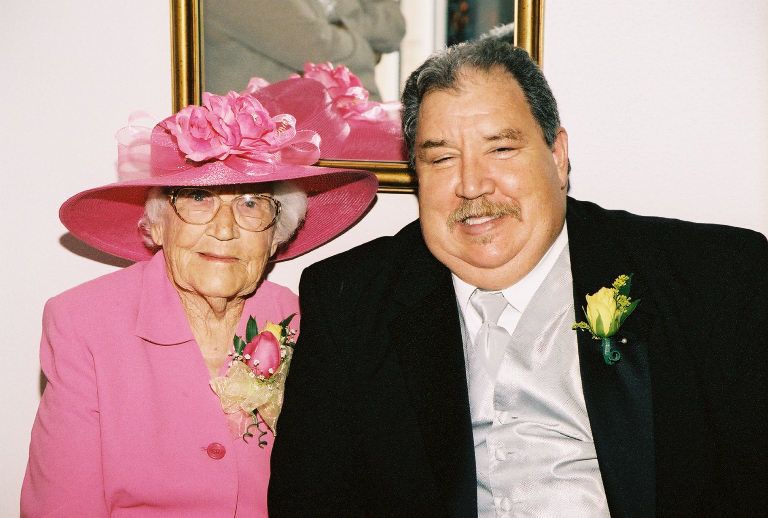
grannie and dad

R.L. Briggs
1943-2011